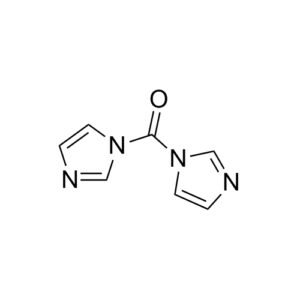
Peptide synthesis is a cornerstone technique in biochemical and pharmaceutical research. Among the reagents facilitating this complex process, 1,1′-Carbonyldiimidazole (CDI) stands out due to its versatility, efficiency, and safety. With the chemical formula C₇H₆N₄O and CAS number 530-62-1, CDI has become a key tool for activating carboxylic acids and forming peptide bonds under mild conditions. In this blog post, we’ll explore the structure, mechanism, and applications of CDI, focusing especially on its pivotal role in peptide synthesis.
CDI is a white to off-white crystalline solid that acts as a dehydrating and condensing agent. It is stable, easy to handle, and generates imidazole as a byproduct, which is relatively non-toxic and water-soluble.
IUPAC Name: 1,1′-Carbonyldiimidazole
Molecular Weight: 162.15 g/mol
Melting Point: ~117–123°C
Solubility: Soluble in organic solvents such as dichloromethane, THF, and DMF.
Peptide synthesis requires the coupling of a carboxylic acid (from one amino acid) to an amine (from another amino acid). CDI facilitates this by activating the carboxylic acid to form an intermediate that is highly reactive toward nucleophiles like amines.
Activation of Carboxylic Acid:
CDI reacts with the carboxylic acid to form an acyl imidazole intermediate.
This intermediate is more electrophilic than the original acid, making it more reactive toward nucleophilic attack.
Amine Attack:
The amine group of another amino acid attacks the activated carbonyl center, leading to amide bond formation (i.e., the peptide bond).
Imidazole is released as a benign byproduct.
This method is particularly valued for its mild reaction conditions, compatibility with protecting groups, and minimal racemization.
✅ Racemization-free coupling: Preserves stereochemistry of amino acids.
✅ Byproduct is water-soluble: Easy to remove in aqueous workup.
✅ No need for strong acids/bases: Minimizes side reactions and degradation.
✅ Stable and easy to store: Solid at room temperature and air-stable.
✅ Compatible with solid-phase and solution-phase synthesis.
Although peptide synthesis is a key use case, CDI also finds utility in:
Esterification and amidation reactions
Urea and carbamate formation
Activation of hydroxyl groups
Polymer modification in material science
CDI should be handled in a dry environment as it is moisture-sensitive. Standard laboratory PPE (gloves, goggles, lab coat) should be used. Although the byproduct (imidazole) is low in toxicity, CDI can be an irritant and should be used under a fume hood.
1,1′-Carbonyldiimidazole (CDI) has earned a reputation as a reliable and efficient coupling agent in peptide chemistry. Its ability to activate carboxylic acids under mild, non-racemizing conditions makes it especially valuable in the synthesis of biologically active peptides. Whether you’re performing solution-phase peptide synthesis or exploring combinatorial methods, CDI is an indispensable tool in your chemical toolkit.